|
|
|
|
|
|
|
|
|
|
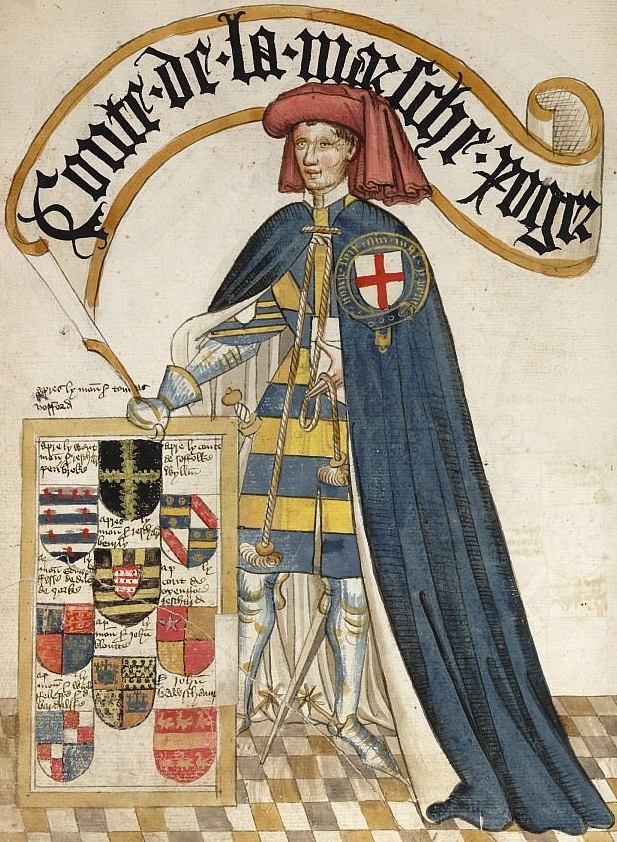
Roger de Mortimer, 3rd Baron Mortimer, 1st Earl of March was born on April 25, 1287 and died on November 29, 1330. Roger de Mortimer married Joan de Geneville, 2nd Baroness Geneville and obtained through marriage to her many properties in the Welsh Marches. Roger and Queen Isabella conspired together and successfully overthrew King Edward II (her husband) in what would later become known as the Despenser War. After imprisonment in the Tower of London, Edward was allegedly murdered per Roger de Mortimer's order. How Edward II died is not quite clear. Afterwards, Roger was the acting King of England for three years before his overthrow by Edward's son, Edward III. For his crimes against Edward III's father and usurping royal power and various crimes, Roger was hung at Tyburn. It is truly fascinating how ancestry works--I am related to Roger de Mortimer through his descendants marrying into my bloodline. So, both Roger and King Edward II (though not proud of his behavior) are my ancestors. |
| Sir Edmund Mortimer was born circa 1302-1303 and died on December 16, 1331. He was born the eldest son of Roger Mortimer, 1st Earl of March. Sir Edmund married Elizabeth de Badlesmere on June 27, 1316 when she was only three years old. Thankfully, the marriage was consummated only after several years passed. Elizabeth's father was hung, drawn and quartered on April 14, 1322 for his involvement in the Earl of Lancaster's rebellion against King Edward II. Elizabeth's mother was imprisoned in the Tower of London until November 3, 1322. Roger Mortimer (below) was one of Edmund and Elizabeth's children. |
|
|
Roger Mortimer was the 2nd Earl of March and the 4th Baron Mortimer. Roger was born on November 11, 1328 and died on February 26, 1360). He was a military commander in the Hundred Years' War as well as English nobility. |
|
|
Edmund de Mortimer was born on February 1, 1352. When he was an infant his father, Roger Mortimer, the 2nd Earl of March died and Edmund became a ward of the crown under King Edward III. Edmund married my ancestor, Philippa Plantagenet of Clarence, daughter of Lionel of Antwerp, 1st Duke of Clarence. I have no readily available portraits of them at this time but the above image is of the ruins of Reading Abbey where Edmund and Philippa were married in 1368. Edmund inherited the title Earl of Ulster when his father-in-law, Lionel died. Edmund Mortimer became the Marshal of England
in 1369. As the Earl of Ulster, he was able to manage and control East Ulster but was unable to assert authority over West Ulster. Edmund died on December 27, 1381 at the city of Cork in Ireland and was interred at Wigmore Abbey. Edmund de Mortimer was my 20th great grandfather. More information on Edmund can be found here.
Philippa was born on August 16, 1355 at Eltham Palace in Kent. She was the only child of Elizabeth de Burgh, 4th Countess of Ulster and Lionel of Antwerp, 1st Duke of Clarence. Philippa's bloodline ultimately put the accession to the throne of England in check and in part precipitated the War of the Roses. Her descendants became the House of York acquiring the throne under Edward IV. Philippa Plantagenet was my 20th great grandmother and it is through her parents that I am related to Queen Elizabeth II (see my Queen Elizabeth II and J. Franklin Rowe, II page). Edmund and Philippa had two sons and two daughters. One of which was Lady Elizabeth Mortimer, my ancestor. |
|
|
|
Sir Henry Percy, also known as "Harry Hotspur" because of his temperament, was born on May 20, 1364 in Alnwick, Northumberland and died July 21, 1403 in the Battle of Shrewsbury. Hotspur was one of the most formidable knights of his time. Henry was also a knight of the Order of the Garter. Henry married my ancestor, Elizabeth Mortimer at an unknown date. They had a son, Henry Percy, 2nd Earl of Northumberland and a daughter, Lady Elizabeth Percy. Sir Henry Percy and Lady Elizabeth Mortimer were my 19th great grandparents. |
This is a likeness of the Pennon of Harry Hotspur Percy captured by the Earl of Douglas, James Douglas. This pennon accompanied Hotspur into battle. In the Battle of Shrewsbury against Henry IV, it is said that Hotspur was killed when an arrow struck him in the head after he had opened his visor. Many did not know that Hotspur was dead and so successful was the onslaught against the King's forces, shouts of "Henry Percy King!" were heard. Upon hearing this, Henry IV shouted "Henry Percy is dead!". Although the outcome of the battle was in favor of King Henry IV, he almost lost his life and the throne of England to Percy's forces. The king had previously promised the lands in and around Cumberland and money to the Percys for their service in war. The king gave these lands to a rival of the Percys instead, going back on his word causing the conflict between them and was almost killed as a result of it. |
|
|
|
|
|
|
|
|
|
|
|
|